Thursday, June 17, 2010

Laser Cleaning of Wall Paintings

Summary of an article from yesterday:

The Laser Cleaning of Wall Paintings
Maria Carolina Gaetani, Ulderico Santamaria; J. Cult. Heritage 1 (2000) S199-S207

 The authors attempt to determine the proper laser parameters for cleaning of frescoes via direct experimentation. The laser cleaning of paintings is an order of magnitude more complicated than the cleaning of stone because of the presence of pigments. In order to maintain the painting, obviously one desires to preserve the pigments. However, the difference between constituent pigments in the paint layers along with their thicknesses and the superimposition of consolidants/protective films requires significant and case-specific laser parameters. 

 The authors attempted cleaning with an Nd:YAG laser at both 532 and 1064 nm. The pulse width was 5-6 ns. Their delivery system could use either a focusing or diffracting optic, leading to irradiation areas of .018 or .38 cm^2. The authors also counted on direct particulate absorption, which depends on the stratigraphic (strata) composition and chromatic characteristics of the materials. The authors tested their results by monitoring pH and specific conductivity, as well as measuring the surface temperature after ablation and carrying out colorimetric tests.

 The first painting the authors attempted to clean was a wall painting representing The Visitation. The laser treatment was applied to a portion of the sky which was in a relatively good state of preservation, but which was blackened due to the stratification of various layers superimposed over the original image during previous restorations. Organic solvents were attempted, but did not allow a selective removal of layers. The authors found that the optimal cleaning condition was 532nm, 10 pulses/s (#pulses unstated) fluence of 1.5 J/cm^2 neither focused nor diffused.  The laser removal did, however, lead to yellowing in one of strata due to photo-oxidation of an oily layer. To completely remove that layer required fluences far superior to the damage threshold of the original paint layer, so a solvent was used. The yellowing was, however, less for 532 nm than for 1064.  The authors attempted the use of water as a cleaning moderator, but found that the bubbles formed damaged the paint layer.

 The second painting was a representation of the Nativity. Mary's cloak had been repainted several times during previous restoration, and consequently had a fragmentary surface. The authors found that using a diffuser, 532nm light at a fluence of .56 J/cm^2 and a 10 pulse/s rep rate yielded the best cleaning without harming the underlying original paint layer.

 The last painting was a representation of The Circumcision. The non-original substances were mainly removed with a pH alkaline saline solution, but small residues remained firmly attached to the surface in tiny fragments. The authors found that the optimal operating conditions were 1064nm light with a fluence range of .8-1.4 J/cm^2. Fluences above 1.4 J/cm^2 caused damage to the original substrate. 532nm light produced no appreciable results. 

 The authors claim that laser cleaning is a valid tool for painting restoration, but requires piece-specific calibration.


Wednesday, June 16, 2010

Translation stage: check

 Good news on the lab front: we now have a motorized translation stage. This is slightly less imperative now that we have a functioning shutter fast enough (hopefully) to let only a single pulse pass, but it should still make life a little easier. The next hurdle is getting beam time and finding out just how good the beam looks and how fast our shutter actually is. If it's not fast enough, we might have to just take Rod's suggestion and use it to dice carrots.

 I attempted cleaning some of the Japanese coins Bianca purchased using two very scientific methods:
1. Toothbrush and soapy water 
2. Q-tip and soapy water
 Neither of which worked particularly well. I currently have two coins soaking in soapy water in cups on my desk. Bianca also suggested methanol, which I went to get, but the lab workers were very hesitant to let me have any (saying "it's toxic" about 10 times. Yes, I know, I promise I won't drink it or let it touch my hands/skin) so I didn't get very much to the point that by the time I got back to the office there was very little I could do with it.

Speaking of the coins:


The resolution is a little cruddy because I took the shots with my laptop's camera, but in any case these are the first photos on this blog of anything directly (physically) related to my experiment. The characters on the coin (read NSEW) are:
寛永通寳
かんえいつうほう (Kanei Tsuuhou; the correct pronunciation of the first word would be something like kan'ei where the n is a syllable by itself)

Kanei was an Era in Japanese history from 1624-1643. Japanese history is broken into "eras" corresponding to the different emperors, for instance, this current year is Heisei 22 since the emperor ascended the throne in January 1989. For more info click here.


Despite the coin being labeled as such, such coins were minted into the 19th century. All the searches I've done for 寳 seem to indicate that the character is slightly outdated and is more typically written as 宝 (treasure) with the same pronunciation. The one on the right means "street" or "way" but as a verb it can also mean something to the effect of diffuse/circulate. So the coin basically says "Kanei Era circulating treasure." Appropriate enough for money. The ones we have were minted in the 1760s. The value on the coin is 4 mon, which wasn't very much.

 I've been looking for a good source for the metallurgical content of the coin and I haven't been able to find much in English, and my Japanese language skill is not up to par with reading metallurgical articles in Japanese without the aid of a Kanji dictionary, which I left at home because it weighs about 5 lbs. The best I have been able to find thus far is this abstract.

Google scholar, UMich and Rochester's databases have turned up nothing on this journal. I may send a very polite email to the corresponding society.

And ask very politely if they have old journals available online somewhere.

Fun fact: the Japanese write "copper" as either 銅 (meaning "same as gold") or 赤金 (meaning "red gold"). The latter is slightly archaic, and stems from a very early period in Chinese history when gold, silver, and copper were all considered gold. "red" was used when the materials needed to be distinguished; silver was "white" and gold was "yellow". The first character was more recent, although by no means modern, and was based on the notion that gold and copper shine in the same manner.

I also read an article on the laser cleaning of wall paintings, but there are some very nice charts in there which are probably going to require a post in and of themselves.

3rd article

A summary of the laser paper I read yesterday

"Lasers Cleaning of Patrimonial Plasters" (LaserS not a typo)
E. Tanguy, N. Huet, A Vinçotte

Due to mineralogical and physical characteristics, plaster becomes dirty quickly. Moreover, traditional plaster cleaning techniques often remove fineness of detail within the artwork.

 The authors fabricated a plaster sample, mixing the powder with only water (no additional additives). As a natural dust contamination process would be extremely lengthy, the authors deposited powdered carbon graphite as a contaminant.

 The authors thermally treated samples of their plaster to determine what modifications of phase could be induced by the ablation pulses. The samples were viewed with SEM after treatment, and were then ground and analyzed via X-ray diffraction. The results are below.
 The authors first attempted using the first harmonic of an Nd:YAG laser (1064), which resulted in "an intense yellowing" of the plaster, while use of the 3rd harmonic (UV) recovered a color "close" to the original plaster.  The fluences used were 2.88 J/cm^2 for the 1064 nm light and .72 J/cm^2 at 355. The discrepancy, not alluded to by the authors, may be enough to cause the yellowing of the plaster. The authors note that cleaning by the fundamental harmonic also morphologically modifies the surface, although the exact modification is not stated. The authors estimate the ablation thresholds of the "dirt" as .16 J/cm^2 and .23 J/cm^2 at UV and IR, respectively. The authors then cleaned a plaster pieta piece using UV laser light at .41 J/cm^2 and achieved "satisfactory results," preserving the details on the piece.


Tuesday, June 15, 2010

Getting Closer...

Today, we (Lei and I) succeeded in getting the shutter functioning with some help from Rod. After consulting the engineering guys, and then (and more importantly) consulting Rob, we figured out that the trigger signal we were trying to use had a frequency far too high for the shutter. We got a signal generator from Rod, and we now have the shutter configured so that it can open and shut as quickly as possible on command. The next logical step is to figure out how fast the shutter is, but we don't have a beam yet.
We're now missing a translation stage driver, two lenses, a CCD camera (which Lei knows how to find) and a beam. Rod's crew are tinkering with a pulse shortening mechanism, so we don't have a cleaning beam yet. However, when their mechanism is finished, we're potentially looking at pulses as short as 5-6 fs, which would be pretty cool. Rod also gave me a tour of their setup, which was cool, but a lot of it went over my head because I know nothing about plasma physics. Also, the Japanese (mon) coins that Bianca purchased came in today, so I'll be stopping by Carrefour tonight and picking up Q-tips to do some very very light mechanical cleaning as a prelude to ablation.
I also read three papers today, which I will summarize now.

Characterization of Laser Cleaning of Limestone
M.I. Cooper et al, Optics & Laser Technology Vol 27 No 1 1995

Limestone, which was a commonly used building material in Europe especially for monuments is composed primarily of calcium carbonate and is chemically susceptible to sulphur dioxide and nitrous oxides, which are common pollutants from the combustion of fossil fuels. Chemical reaction between the stone and pollutants lead
to the formation of a gypsum crust. From there, a buildup of soot particles with small amounts of metal, rubber, and asphalt results in the formation of a black crust, the removal of which is desirable.
The authors made use of the different absorption spectra of the limestone and crust; at 1060 nm (Nd:YAG) clean limestone absorbs about 30% of the radiation while the black crust absorbs 90%. The cleaning is thus a self-limiting vaporization process. The authors used a Nd:YAG laser with a 300mJ/pulse limit, pulse duration 6ns, and a rep rate of 10 Hz focused to "a desirable" (i.e. unstated, and probably not measured) fluence. The authors also extolled the virtues of applying a thin layer of water, the explosive evaporation of which removes particulates at lower fluences. When the crust is removed, boiling of w ater due to heating of the limestone is minimal.
The experimental layout used by the authors is shown below.
The calorimeter was used to monitor the output energy of the Nd:YAG laser. The HeNe laser was used to monitor the amount of removed material by the intensity of HeNe scattering recorded. The acoustic monitoring was an interesting idea. Ap parently when material is ablated and rapidly released from a material, the ejection creates an audible shock pulse. The authors found a linear relation between material ablated and shock pulse amplitude, with the slope being greater by an order of magnitude for "wet" cleaning. However, the shock amplitude is dependent on the angle from the sample's normal at which the microphone is held, so care has to be taken to maintain angle during the experiment. In terms of laser ablation, the experiment was successful, and preserved detail on the limestone quite well, with the cleaning being more effective upon the addition of water.

Laser Cleaning in Art Restoration
Gobernado-Mitre et al, Applied Surface Science (1996) 474-8

The author and his compatriots used a 7ns pulse Nd:YAG laser at 1064 at a rep rate of 20 Hz in an attempt to clean limestone from the Santa Cruz Palace. They characterized their samples using X-ray diffractometry, IR spectroscopy, and micro-Raman spectroscopy. The authors also used optical microscopy and SEM to morphologically analyze their samples.
The authors found that the samples they were using were mainly composed of dolomite CaMg(CO3)2, small amounts of gypsum CaSO4 x 2H2O and quartz, SiO2. The gypsum was probably due to weathering of the building to airborne pollutants, leading to chemical degradation via exposure to SO2 in the air or rain.
The authors used various numbers of incident pulses and studied ablation depth. The results are below.
The author observes that a natural "over-painting" exists on the cleaned stone for fluences of 200 mJ or less, but which is ablated by 2 400 mJ pulses.

The last paper I read was on plasters, but I'm falling asleep at the keyboard now, so any summary I write is going to be unintelligible. Will update tomorrow.

Monday, June 14, 2010

Table of Results


The above table lists the articles I've read in the past week along with the results obtained within. The three at the end labeled "no applicable results" were theory papers or background info and contained no data.


Sunday, June 13, 2010

End week 2

I meant to post this last night but our wireless died around 10. It just now went back up.

I've been feeling tired these past few days, so I've fallen behind with the blogging. Sean and Johanna were (and still are) sick this week, and Michelle was sick before them, so I'm trying to avoid whatever's going around with OJ, sleep, and food.

On Thursday, I finished reading Chichkov et al's "Femtosecond, picosecond, and nanosecond laser ablation of solids" article. His results are fairly predictable to me now that I've read quite a few papers; fs lasers reduce thermal effects and make for cleaner ablation than ns pulses, although ps pulses also fair pretty well. Chichkov actually went into some of the thermodynamics behind the 2 step model, which I followed as best I could, but he skipped quite a few steps and my grasp on Thermodynamics is par at best. I also spent some of Thursday and then Friday reading a paper on the formation of corrosion products of Copper in the presence of sulfur. Since I'll be ablating primarily wartime nickels, primarily copper, and since sulfur was strongly present during the war years due to its use in an industrial setting, that seemed like a good choice for starters. Bianca asked me to make a table of the results of the papers I've been reading, so that should be up here today, hopefully.

By some coercion, bribery, devilry, or blackmail, Corinne manage to get me an opthamologist appointment for Friday, which I happily took. We got lost on the way there, one of the procedures made me very dizzy and light-headed, and I got lost finding my way to the RER station afterward (promptly followed by a second trek of the day up the Palaiseau hill) but I finally have lab clearance.

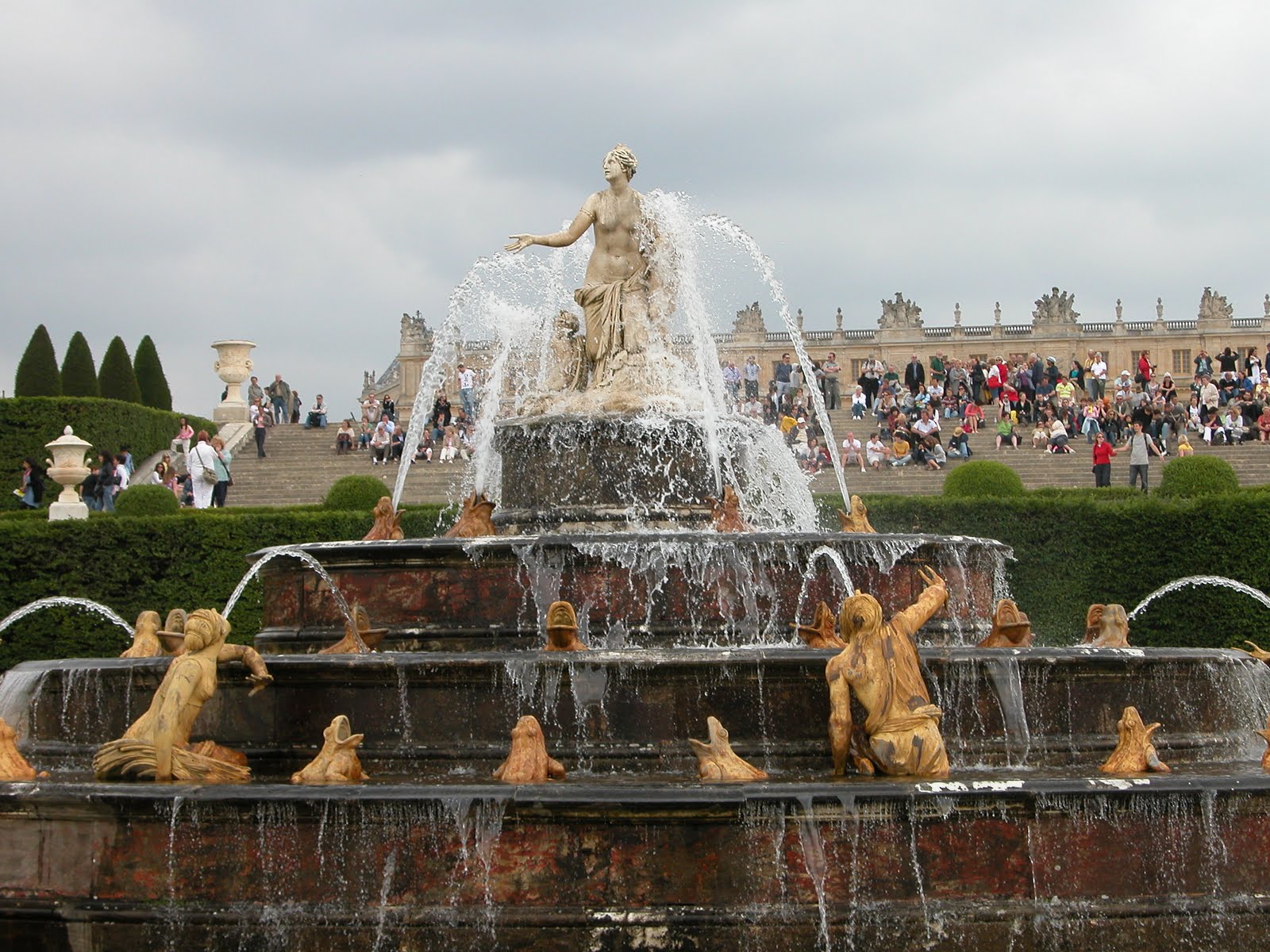
On a personal note, we went to Versailles on Saturday with students from Paris tech. The gardens are quite fantastic.
Hey, these statues look somewhat dirty/corroded. Maybe they'd let me irradiate them. I mean, really, what's the difference between a 60 year old coin and a 300+ year old statue?

Wednesday, June 9, 2010

Laser Safety Step 1: Don't Stick Your Head in the Beam Path

I went to see Yvres-Bernard this morning and picked up the laser safety video which I watched after lunch time. I went over the English version of the laser safety test that he gave me and asked Bianca to check answers with me. I then went to see him again and actually took the test with a bunch of other people, including Lee. Since my French is horrendous (translation: nonexistent) I just took the English language version. I finished in about 10 minutes, but Yvres waited for everybody to finish and discussed the answers (kindly in English and French) with everybody, so the entire test process took a little more than an hour. Afterwards, he gave me laser safety goggles on the condition that I return them at the end of July.

Just before taking the test, I talked to Valerie at LOA, who confirmed for me that if I managed to get an outside opthamologist to do the testing, my expenses would be covered. Using the HTH's doctor database, I found 8 opth. near Paris that I could go to, and with Julien's help (I'm really going to owe him by the end of the summer) I got in touch with 5 of them. I found out that 2 don't have the equipment, and of the 3 that can, one offered an appointment for 6/28, one cost about 200e, and one required that I come in for a consultation (after a month's wait) and then wait 2 months before the opth. appointment... We're going to try the other 3 tomorrow, but neither Julien nor myself are holding out much hope. Yvres-Bernard suggested asking Corrinne to get in touch with the people who usually do it and try to get my appointment moved up. I'll ask her, but I'm not sure how successful she's going to be.

On the research side of things, I finished reading another paper today.
Applied Surface Science 233, 2004
The authors begin by stating the reason for the suggestion of an incubation model, namely, materials irradiated with multiple pulses in succession were damaged at lower fluences. According to the authors, though, "the fundamental physical mechanisms of material removal during laser ablation are not clearly understood as yet."

The authors then mention 3 possible types of ablation processes: vaporization, normal boiling, and explosive boiling (also known as phase explosion, wherein materials are superheated-->vaporization). For short pulse lasers, the first two are apparently insignificant.

The authors next mentioned the morphological phenomenon of surface rippling, although they didn't say much about it. The next paper I'm reading, by Fauchet among others, deals with this explicitly.
The authors then described two ablation "phases", gentle and strong. During gentle ablation, which occurs at fluences just above the threshold the ablation rate is low, and ripples appear. Strong ablation is at fluences well above threshold, and results in rougher surface effects. The author also mentions that they are using the two step model for ablation. The model is as follows (fom Qiu and Tien, 1992, which I've half read and will finish reading soon...hopefully):
1. Incident photons interact with free electrons in the metal, exciting them to higher energy levels. The excited electrons are extremely far from thermal equilibrium and may be thought of as a free electron gas.2. The electrons diffuse through and heat the metal lattice (comprised of phonons) via electron-phonon collision. Due to the difference in mass, it takes 10s of collisions to transfer significant energy from electrons to phonons. The approximate collision time at room temperature (ambient) is 20fs, so the electron phonon relaxation time is on the order of picoseconds. If the laser pulse is much longer than this time then the electrons and phonons will reach local thermal equilibrium and a 2 step model is unnecessary. If however the pulse is shorter, the electron-phonon interaction is significant.
The authors measured the inclubation coefficients and ablation thresholds for four materials (below) using a Ti:Sapphire laser, 775 nm central wavelength, 150fs pulses, for differing numbers of shots. As predicted, as the number of incident shots was increased, the diameter of the ablated spot also increased.

The incubation model is as followed. Assuming a Gaussian beam, the diameter of the ablated spot may be described as:Where wo is the 1/e^2 beam waist, phio is the peak fluence, and phith is the ablation threshold fluence. For N shots,
One can determine the ablation threshold by plotting the first equation (for D^2) and finding the value of Phith for which D^2 is 0, since phi0 may be calculated via measuring the total pulse energy.

The results from the paper are as follows:
The authors also detailed a method for studying Phith(N) as a function of depth removed per pulse, but since that is somewhat removed from my project, I will not describe it here.