Sunday, June 13, 2010

End week 2

I meant to post this last night but our wireless died around 10. It just now went back up.

I've been feeling tired these past few days, so I've fallen behind with the blogging. Sean and Johanna were (and still are) sick this week, and Michelle was sick before them, so I'm trying to avoid whatever's going around with OJ, sleep, and food.

On Thursday, I finished reading Chichkov et al's "Femtosecond, picosecond, and nanosecond laser ablation of solids" article. His results are fairly predictable to me now that I've read quite a few papers; fs lasers reduce thermal effects and make for cleaner ablation than ns pulses, although ps pulses also fair pretty well. Chichkov actually went into some of the thermodynamics behind the 2 step model, which I followed as best I could, but he skipped quite a few steps and my grasp on Thermodynamics is par at best. I also spent some of Thursday and then Friday reading a paper on the formation of corrosion products of Copper in the presence of sulfur. Since I'll be ablating primarily wartime nickels, primarily copper, and since sulfur was strongly present during the war years due to its use in an industrial setting, that seemed like a good choice for starters. Bianca asked me to make a table of the results of the papers I've been reading, so that should be up here today, hopefully.

By some coercion, bribery, devilry, or blackmail, Corinne manage to get me an opthamologist appointment for Friday, which I happily took. We got lost on the way there, one of the procedures made me very dizzy and light-headed, and I got lost finding my way to the RER station afterward (promptly followed by a second trek of the day up the Palaiseau hill) but I finally have lab clearance.

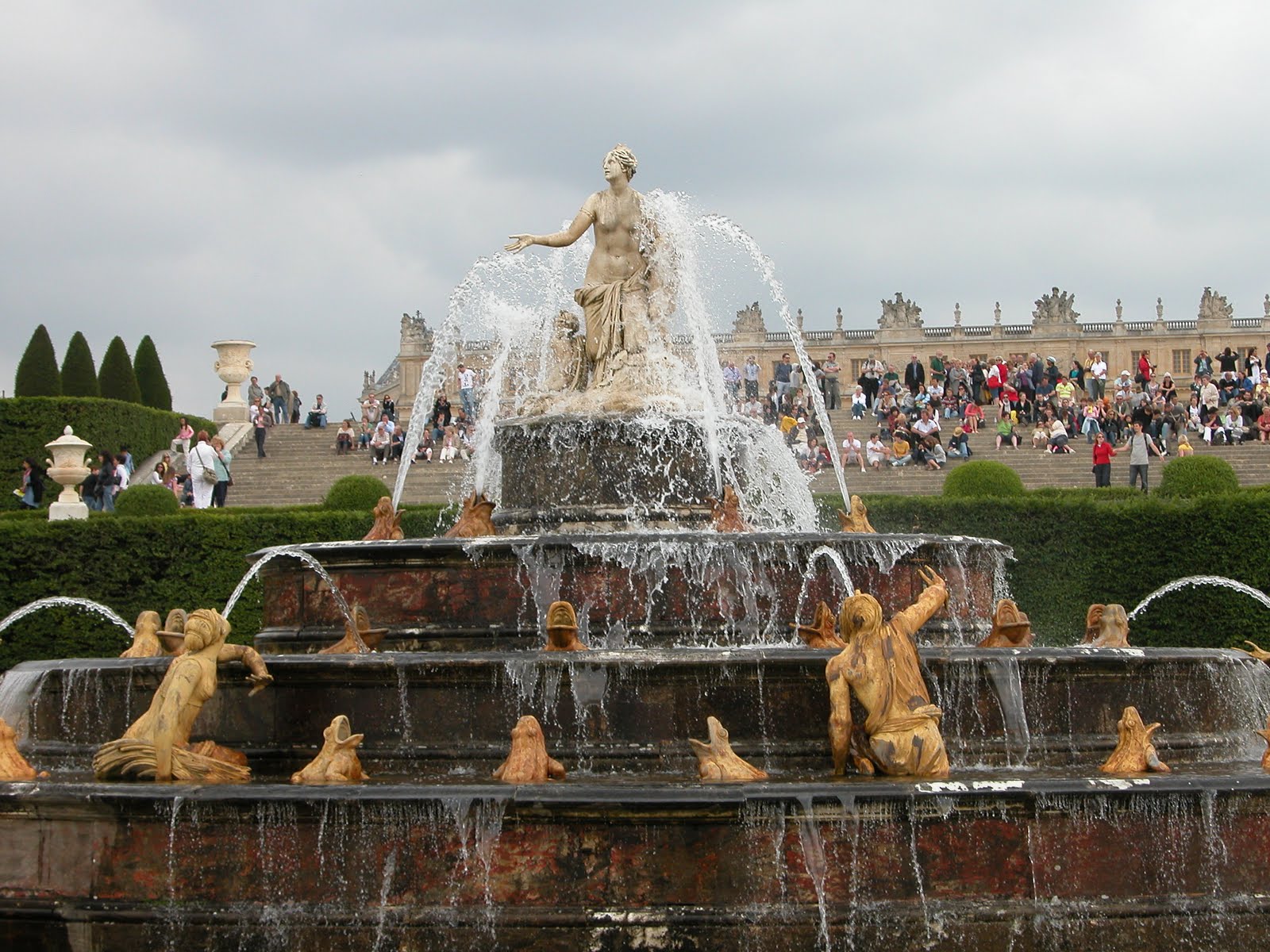
On a personal note, we went to Versailles on Saturday with students from Paris tech. The gardens are quite fantastic.
Hey, these statues look somewhat dirty/corroded. Maybe they'd let me irradiate them. I mean, really, what's the difference between a 60 year old coin and a 300+ year old statue?

Wednesday, June 9, 2010

Laser Safety Step 1: Don't Stick Your Head in the Beam Path

I went to see Yvres-Bernard this morning and picked up the laser safety video which I watched after lunch time. I went over the English version of the laser safety test that he gave me and asked Bianca to check answers with me. I then went to see him again and actually took the test with a bunch of other people, including Lee. Since my French is horrendous (translation: nonexistent) I just took the English language version. I finished in about 10 minutes, but Yvres waited for everybody to finish and discussed the answers (kindly in English and French) with everybody, so the entire test process took a little more than an hour. Afterwards, he gave me laser safety goggles on the condition that I return them at the end of July.

Just before taking the test, I talked to Valerie at LOA, who confirmed for me that if I managed to get an outside opthamologist to do the testing, my expenses would be covered. Using the HTH's doctor database, I found 8 opth. near Paris that I could go to, and with Julien's help (I'm really going to owe him by the end of the summer) I got in touch with 5 of them. I found out that 2 don't have the equipment, and of the 3 that can, one offered an appointment for 6/28, one cost about 200e, and one required that I come in for a consultation (after a month's wait) and then wait 2 months before the opth. appointment... We're going to try the other 3 tomorrow, but neither Julien nor myself are holding out much hope. Yvres-Bernard suggested asking Corrinne to get in touch with the people who usually do it and try to get my appointment moved up. I'll ask her, but I'm not sure how successful she's going to be.

On the research side of things, I finished reading another paper today.
Applied Surface Science 233, 2004
The authors begin by stating the reason for the suggestion of an incubation model, namely, materials irradiated with multiple pulses in succession were damaged at lower fluences. According to the authors, though, "the fundamental physical mechanisms of material removal during laser ablation are not clearly understood as yet."

The authors then mention 3 possible types of ablation processes: vaporization, normal boiling, and explosive boiling (also known as phase explosion, wherein materials are superheated-->vaporization). For short pulse lasers, the first two are apparently insignificant.

The authors next mentioned the morphological phenomenon of surface rippling, although they didn't say much about it. The next paper I'm reading, by Fauchet among others, deals with this explicitly.
The authors then described two ablation "phases", gentle and strong. During gentle ablation, which occurs at fluences just above the threshold the ablation rate is low, and ripples appear. Strong ablation is at fluences well above threshold, and results in rougher surface effects. The author also mentions that they are using the two step model for ablation. The model is as follows (fom Qiu and Tien, 1992, which I've half read and will finish reading soon...hopefully):
1. Incident photons interact with free electrons in the metal, exciting them to higher energy levels. The excited electrons are extremely far from thermal equilibrium and may be thought of as a free electron gas.2. The electrons diffuse through and heat the metal lattice (comprised of phonons) via electron-phonon collision. Due to the difference in mass, it takes 10s of collisions to transfer significant energy from electrons to phonons. The approximate collision time at room temperature (ambient) is 20fs, so the electron phonon relaxation time is on the order of picoseconds. If the laser pulse is much longer than this time then the electrons and phonons will reach local thermal equilibrium and a 2 step model is unnecessary. If however the pulse is shorter, the electron-phonon interaction is significant.
The authors measured the inclubation coefficients and ablation thresholds for four materials (below) using a Ti:Sapphire laser, 775 nm central wavelength, 150fs pulses, for differing numbers of shots. As predicted, as the number of incident shots was increased, the diameter of the ablated spot also increased.

The incubation model is as followed. Assuming a Gaussian beam, the diameter of the ablated spot may be described as:Where wo is the 1/e^2 beam waist, phio is the peak fluence, and phith is the ablation threshold fluence. For N shots,
One can determine the ablation threshold by plotting the first equation (for D^2) and finding the value of Phith for which D^2 is 0, since phi0 may be calculated via measuring the total pulse energy.

The results from the paper are as follows:
The authors also detailed a method for studying Phith(N) as a function of depth removed per pulse, but since that is somewhat removed from my project, I will not describe it here.

Tuesday, June 8, 2010

Red tape, red tape

I came in this morning and read about half of two separate articles... I started reading a paper on a 2-level model of laser ablation, but I was having trouble concentrating, so I started reading "The effect of damage accumulation behaviour on ablation thresholds and damage morphology in ultrafast laser micro-machining of common metals in air" by Mannion et al. I'll summarize both when I finish them.

After lunch, I helped Lei align the He-Ne in the lab. Since the He-Ne is such low power, my untested knowledge of laser saftey is adequate. The system is now almost entirely set up optically except for the lenses and CCD. We need to see an electronics guy about the shutter, since the trigger apparently needs more voltage than will currently reach it. We're also apparently waiting for another translation stage for the sample.

I got back to the office and found out from Bianca that although we do have the bon du commande, the earliest the ophthalmologist with whom the Ecole seems to have a preferential relationship could make an appointment was 7/1, which is frankly ridiculous. I'm going to ask Julien to help me call them tomorrow, but if they can't do anything, I've already found 4 other possible opth.s through HTH's website. The health insurance won't cover it because it's not illness related, and it would be 90e out of pocket with the POSSIBILITY of being reimbursed...because of the relationship between the ecole and the opth. they want me to go to...

So the upshot is that I was really not in a good frame of mind at the end of the day, and that if Julien can't help me convince the nearby people to give me an appointment sooner, I've got the decision between paying quite a bit of money and getting the thing done, or sitting around unable to do research for 3 weeks.


At least the day ended well. Francois invited us to a party at ENSTA, where we were pretty well welcomed by the French students.

Bureaucracy is a French Word. Efficiency isn't.

Today I went to see Yvres-Bernard to get the laser safety exam and watch a laser safety video after which I'm allowed access to the laser lab. However, we discovered two things:
1. The video is currently MIA, or at least somebody has it borrowed from Yvres-Bernard
2. I need to get a retinal scan/eye exam before I can even take the exam.

I'm not concerned about the exam. I've studied for it a bit, and the laser safety stuff we did at CUOS seems to more than cover the material. The retinal scan issue came as a surprise, and apparently there's a problem requisitioning the proper paperwork because apparently I'm technically LOA and Corinne (who's been extremely helpful so far) is ILE... or maybe I have that backwards. In any case, it took all of today to figure out who was actually going to cover the exam, and since we can't make an appointment until we have a "bon du command" which I take to be a declaration of payment, that's going to get done tomorrow. I'd be ok covering it up front with cash and then being reimbursed, but apparently that's even more of a bureaucratic pain. I was looking forward to actually getting some lab time in, but it doesn't look like that's happening within the next few days.
So instead, I spent most of today reading articles.
Article from SPIE proceedings vol. 7027, 2008. (all images taken from above article)

This group of researchers from Athens conducted research on laser-based cleaning of coins, using a Roman coin (minted c. 120 AD) and a Byzantine coin minted some time in the 6th century A.D. The Roman coin was relatively well preserved, but covered in a thin green corrosion product the authors identified as Copper Chlorite, while the Byzantine coin showed evidence of multiple different colors and types of corrosion products.The group used XRF (X-Ray fluorescence) to monitor the amount of each chemical compound in the corrosion products; that is to say XRF was used to monitor the removal of certain products by change in emission spectra.

The group attempted cleaning with several different laser systems, including an Nd:YAG which they used at 266, 532, and 1064 nm with a pulse width of 6ns and a rep rate of 10Hz, an Er:YAG of 2.94 um wavelenth with 190ns pulses at a rep rate of 1 Hz, and a TEA CO2 laser 10.6 um, 80 ns pulses, 1-5 Hz rep rate. The pulsed beams were focused by a lens of f=50 onto the coins. According to the authors, fluences ranged from 2-19.2 J/cm^2.

In terms of general results, the authors found that using a larger number of pulses resulted in a greater display of thermal effects in the material. Lower fluences were preferable, except that below a certain threshold the coins were poorly cleaned, or not cleaned at all. The authors also tested the coins in "wet" and "dry" conditions, although they failed to define what those definitions meant. My understanding is that "wet" means they applied a thin film of liquid to the coins before irradiating them, but the paper was not explicit.

The authors also mentioned an additional way to characterize the cleaning. The Roman coin in question was a quaternary alloy of Tin, Lead, Silver, and Copper. Apparently there exist two X-rays in Tin's spectrum, denoted La and Ka, where the La X-rays are significantly absorbed if some material exists above Tin, but which radiate strongly if Tin is in strong concentration at the substrate surface. In other words, once the ratio is large ("large" being not well described in the article) the cleaning has made significant process.
Ultimately, the authors found the presence of water helpful, and their best results were obtained by the 532nm Nd:YAG at fluences of about .93-1 J/cm^2

Proceedings of SPIE, vol 7391, 2009

The same heroes from last time, plus a few new faces, study the cleaning of ancient coins, here a coin minted in Cologne around 260 AD and a Roman coin minted in Alexandri in 315 AD. Both coins contain a high concentration of copper; the Cologne coin (designated NMW56 in the paper) was 91% Cu, 3% Ag 3% Sn and 3% Pb roughly, while the Roman coin (R2) was 83% Cu and 17% Ag. The authors stated that composition and structure of the corrosion layers had not
been fully investigated, but that they were mainly comprised of copper corrosion products. The authors used optical microscopy, SEM, and a stylus profilometer to determine cleaning efficiency. The authors used and compared 4 different lasers:

With repetition rates of 10, 1, 490e6, and 5e3 Hz respectively.

For the Nd:YAG laser at 532 nm, the authors reused data from a previous paper (the one about cleaning coins as a function of wavelength). They stated the result of most successful cleaning between .93 and 1 J/cm^2 but stated that the nonhomogeneity of the corrosion products complicated cleaning.

For the Nd:YAG at 1064, in a microscopic photo, the uncleaned area of the coin actually appears more homogeneous that the cleaned area due to melting/reforming of copper and budding exposure of Ag. Most of the corrosion products were successfully removed successfully.

For the GaAlAs Diode laser, the beam had to be tightly focused only to achieve a max fluence of ~.06 J/cm^2. Also, with such a high repetition rate, many more pulses hit each area than with the Nd:YAG laser (appx 10^8 pulses/spot according to the author). Given the author's previous claim that multiple shots lead to thermal effects, I have a hard time seeing this measurement as being comparable with the Nd:YAG results. In terms of results, the authors found that the diode laser successfully removed corrosion products but was not intense enough to remove cover covering the coin's silver outer coating. Personally, I think this sounds quite useful, as it managed to blast off the corrosion products without possibly harming the delicate (um thick) silver coating.

For the Ti:Sapphire laser, the authors found that the pulses removed not only the corrosion products, but also the copper AND delicate silver layer they were trying to protect, and concluded that for this specific operation, it wasn't the tool to use. The pulse rate was such that, at the two scanning speeds the authors attempted, either 1 or 4 pulses hit the same spot on the coin. The authors concluded from the variations in the Nd:YAG trials that perhaps the corrosion product behaved significantly differently for visible and IR radiation, which may have also affected the Ti:S's utility.

It is interesting to note that while this paper purports to compare cleaning as a function of pulsewidth, the repetition rate of the ps laser was such that a great number of pulses hit each spot, and also that the wavelength of the fs laser was such that cleaning may have been impractical regardless of pulse width. The authors even mention in the second to last paragraph that more work needs to be done since the test wasn't a fair comparison of fs, ps, and ns lasers.

As something of an aside, I find the focusing mechanism used in these papers interesting. Every time, the author just seems to mention "a lens of focal length" whatever which causes the beam to focus. But I can imagine that using just one lens would lead to significant beam aberrations especially in larger beams, especially from spherical and chromatic aberrations, particularly for short pulses which have a larger bandwidth. I would be interested in seeing the result of using a well-corrected lens system as opposed to a singlet lens used to focus the beam.
Monday, June 7, 2010

End week 1

The weekend was pretty unproductive for me. Lee, Sean, and myself tried to figure out what sort of sports/activities are available at the Cité on Saturday, and were severely disappointed. You need a membership card to use the pool. The membership card costs 20e and is available at some office which is closed over the weekends, and quite possibly is open 9-5 during the week, which means we'll have to either go in late or leave work massively early to get a pass. You also need a membership card to play tennis or basketball, or pretty much anything. The only thing free is pick-up games on the fields, so we went jogging and then played frisbee for a while on Saturday.

I went to mass again this week at the Irish chapel by the Luxembourg RER stop. On the way back, I successfully gave directions to an Irish guy I met at mass, so I guess I'm finding my way around pretty well at this point. I also did laundry (quite an adventure when there's 2 washers and 1 dryer for several buildings) and skyped with people at home.

On a more work related note, this is a schematic of the layout I'll be playing with for the next few weeks.
Light is emitted from the cleaning laser (which in our case is a pretty small tap off of the laser being used by another group). The light, which is initially linearly polarized, is shot through a half-wave plate and a linear polarizer, the combination of which functions as a variable attenuator. The pulsed beam is then shot through an electronic shutter, which ensures that only one pulse makes it through the rest of the system. The pulse is then reflected off of two dielectric mirrors (reflective at IR wavelengths the pulsed laser is operating at, but mostly transmissive at visible wavelengths) and focused on the sample/subject of cleaning. Simultaneously, a HeNe laser is used to illuminate the sample, and the reflections of said HeNe off of the sample are imaged to a CCD. The reflection profile will be used to monitor changes to the sample.

Friday, June 4, 2010

Day 5.1 (summaries of articles I read yesterday)

"Femtosecond Laser Cleaning of Painted Artefacts; Is this the Way Forward?"

P. Pouli, G. Bounos, S. Georgiou, and C. Fotakis

Springer proceedings in physics

LACONA VI Proceedings, Vienna, Austria, Sept 21-25 2005

This article primarily discussed femtosecond lasers versus nanosecond lasers as cleaning tools for direct ablation of varnish. The author states that it is known that fs lasers are more efficient because:
1. They are able to process even nominally transparent substrates
2. They minimize thermal diffusion throughout the substrate (diffusion in extreme cases can lead to melting and the creation of an even more difficult to clean mess)
3. The pulses are so short that there is no plasma shielding

The author the proceeds to talk about photochemical interactions, which are, as the name might suggest, chemical reactions which are initiated by the presence of light. These are especially important for the case of painted artifacts, due to the photolability (ability or likelihood of a material to change chemically due to interaction with light) of the painted substrates.  

The author next proceeds to define effective cleaning as based on:
1. Spatial resolution (etching efficiency) and ablation threshold
2. Extent of induced photochemical modifications
3. Morphology of ablation spots.

In general, fs lasers can ablate materials at much lower fluences than ns lasers. According to the experimental data presented in this paper, the ablation rate is roughly material independent.

The authors monitored the photoproducts formed in the varnish via LIF (Laser-induced Fluorescence). Apparently the disassociativity and activity of the dopant used are extremely sensitive to alterations in the polymer environment; in other words, the photoproduct activity can lead to a good understanding of photochemistry in the varnish layer. The authors found that product formation via photochemistry was much reduced for fs pulses. The two pulses of different widths behaved similarly under the ablation threshold, but above it, fs length pulses exhibited less thermal effects and less photochemical effects.

In terms of surface morphology, the authors found that fs pulses were also more effective. The fs lasers produced clean, small cuts, while the ns lasers exhibited some melting effects.

In  short, the authors found that fs pulses are better in all respects. Unlike Tam’s article, this process is applied directly to the varnish, probably because the paints would react in a way unpleasing to conservators if the steam cleaning method or some other substrate heating method were attempted. The authors found that the etching depth for both varnishes they used was much less for fs pulses, allowing for more precise cleaning.

“Experimental Study on the Effect of Wavelength and Fluence in the Laser Cleaning of Silvering in Late Roman Coing”

Vlachou-Mogire, Drakaki, Serafetinides, Zergioti, Boukos

14th International School on Quantum Electronics: Laser Physics and Applications

SPIE Vol. 6604, 66040W (2007)

Due to economic turmoil in the later periods of the Roman Empire, previously silver Roman coins began to be made from an alloy of copper containing led, tin, and silver. The coins were then coated with silver in a film a few micrometers thick. Wear and corrosion can destroy any detail from the silver layer, but more importantly, mechanical cleaning of the coins can easily remove the silver layer, thus the necessity for more precise methods.

The authors irradiated the coins with a Q-switched Nd:YAG laser with 6ns pulses, 10 Hz repition rate, and between .1-7 J/cm^2 possible fluence.  They used both 532nm and the second harmonic 266 nm pulses, comparing the two in terms of cleaning utility.

The authors found that a fluence in the neighborhood of .93-1 J/cm^2 was most effective for the removal of the corrosion products.  For both silver and copper, the diffusion length is typically less than the corrosion layer depth, but the diffusion length is modified by the presence of the corrosion products, so such an approximation is not always valid, and the user must procced with extreme care (use the lowest effective fluence possible) to remove the corrosion products. The authors also found that at fluences well below the threshold, the material blackened. They postulated that this was due to another chemical reaction in which Cu2OàCuO. In other words, too low a fluence as well as too high a fluence resulted in deterioration of the coin surface

Finally, the authors found that the 532 nm light cleaned far more effectively than the 266 nm light, and postulated that this is due to metals absorbing strongly in the UV as compared to the IR, which would lead to surface melting. 

Work, Day 4

I spent today reading a few more papers which I will summarize here.
"Laser-Cleaning Techniques for Removal of Surface Particulates" by Tam et al

The paper begins by summarizing what it considers the 3 most important attractive forces between particulates and the varnish/object substrate to which they attach. The three forces are the Van der Waals force, the capillary force, and the force of attraction between an induced double layer of charge. The magnitude of each force exceeds the force of gravity.

The Van der Waals is typically predominant for particulates less than a few microns in diameter, and is the force of attraction between an instantaneous dipole in one body and an induced dipole in another. The most important facet of this attractive force is that it scales as d/z^2, where d is the particle diameter and z^2 is the microscopic distance between the particulate's surface and the surface of whatever substance it is attracted to. Although d will decrease for smaller particles, the particle density will greatly increase, and in general smaller particulates are harder to remove. However, this model assumes no compression/deformation of the particulate in the area of contact. Tam says that the VdW force is much greater if there is compression, but fails to mention by how much.

The capillary force is the "suction" force which may be present if a layer of liquid is trapped between particulate and substrate. It scales as d.

The force resultant from attraction between a double layer of charges results from charge transferral upon contact between particulate and substrate, which creates a contact potential of some magnitude at the border region. It scales as d/z.

Note that each of the attractive forces scale as d. Assuming mass ~d^3, employing force balance and F=ma, one needs an acceleration which scales as 1/d^2 to remove the particulate. In other words, smaller particles are more difficult to remove.

Tam then proceeds to describe a few processes for laser cleaning, defining efficiency as the removal of smaller particles with lower fluence and fewer pulses so as to maintain substrate integrity. The first process was dubbed Dry Cleaning, in which the substrate is hit with a laser wavelength at which it strongly absorbs radiation. The substrate then expands thermally and ejects the particulates. The governing equation is:(I haven't figured out how to use Greek letters on blogger yet)
A second related method involves blasting the object with laser light at a wavelength where the particulates strongly absorb. If the fluence is high enough, the particulate will sublimate or ablate.

The process Tam seemed more excited about he dubbed "Steam laser cleaning" wherein the surface of the object under test is coated with a thin film of water or a solution with a high concentration of water and a low concentration of ethanol and then hit with laser light. There are three types of such cleaning, the most efficient of which was called "Strong substrate absorption." The particulate/solution/substrate mix is hit with a laser pulse of a wavelength such that the water and particulates strongly transmit, but the substrate strongly absorbs. The material then superheats the water in the solution, causing explosive evaporation which removes particulates.
It is this ability to be superheated which makes water preferable to a purely ethanol solution, but high surface tension of the water makes the addition of ethanol to allow liquid diffusion between particulates advantageous.

The other methods of steam laser cleaning were film absorption, which is problematic because absorption occurs mostly at the film/air interface and does not result in the ejection of many particles, and partial substrate absorption, which requires a higher laser fluence and may damage the substrate.

Those are the basic principles. An important side note is that the pulse width (temporal) is limited on the lower end by the necessity to superheat the water and on the higher end by worries about damaging the material with high intensity laser light.

I also read Fotakis et al's "Femtosecond Laser Cleaning of Painted Artefacts; Is this the Way Forward?" and Drakaki et al's "Experimental study on the effect of wavelength and fluence in the laser cleaning of silvering in late Roman coins (Mid 3rd / 4th century AD) ". I'll post a summary of those papers tomorrow morning either before I leave for work or when I get there.