Monday, July 26, 2010

The home stretch

A lot has happened since my last post. Julien and I went to the C2RMF again last Thursday. After some unsuccessful attempts to get the microtopography apparatus to function, we performed optical microscopy and SEM on KETH kurai, the Roman coin, and AN43U. Bad news first: we did absolutely nothing to the Japanese coin. I suppose the fluence we were using (~150 mJ/cm^2) wasn't quite enough to break through the corrosion layer. The ablation marks on the Roman coin were visible with naked eye.
The correct description for this coin is:
a.) Toasted
b.) Well done
c.) It resembles R2D2 after the battle of the first Death Star
d.) All of the above

If you picked d., congratulations! Yeah, so we hit this coin with way too much energy. From right to left (i.e. most to least visible) the craters are from 1000, 500, 100, 50, 10, 5, and (barely visible) 1-2 pulses. I say 1-2 because the shutter isn't good enough to reliably pick off one shot. The second smaller spot is probably due to a ghost reflection off of the dielectric mirror, but evidently it carried enough energy to ablate the coin. Unfortunately, the day I shot at the Roman coin the energy meter was missing, and the following day Rod and Xiaowei tinkered with the laser, so I don't know the total energy in the pulse train. Using the equation that avg energy = average power/ rep rate, and using the spot size measured with the CCD camera, I estimate that the large spot is approximately 11.5 J/cm^2 while the small spot is 2.5 J/cm^2. That would explain the char marks.

I was pleasantly surprised with the nickel. Nothing was visible, even under the optical microscope at 20x visibility, but the SEM showed otherwise.
The lines are, from right to left: 500, 100, 50 (higher rate), 10, and 5 pulses incident. The ablation spots are really quite nice, and the EDX results show a successful removal of corrosion products.

On Friday, we had a group meeting with Dr. Mourou. I showed him the SEM results and he seemed happy with them. I really wish I had more time to do research now that the setup is functioning and none of the pieces are missing.

I spent Friday and today making my presentation for Wednesday. The students are meeting with Steve Yalisove tomorrow to discuss the projects/summer overall, and everybody is giving presentations on their work Wednesday.

Tuesday, July 20, 2010

I've ablated something! ...I think

As predicted, Bianca and I spent pretty much all day in the lab Tuesday. After realigning some misaligned components, and relocating the CCD camera--of all the components in our system that one is particularly problematic as it tends to wander off on its own a lot--we got to shooting. We used KETH kurai and went around the rim, varying the number of bursts. We had the shutter set for the lowest (quickest) setting, so we were getting 1-2 pulses per burst. No damage was visible to the naked eye.

Wednesday was Bastille day. I slept in, planned for my trip to Ireland, and went to the Eiffel tower to see the fireworks. The fireworks, although pretty cool, were not overly impressive. I wound up walking back to Cité U from there because there were so many people and the metro was packed. Many of the buses were not running, probably because of all the people in the streets.

I came in on Thursday and experimented with the shutter. After tracking down the manual online, I figured out how to change the duration of the open and close cycle. I wanted to see how precisely the shutter's timer was, but something electrical was wrong with the laser and I didn't get the chance. I spend the afternoon making a presentation for Bianca of the SEM results.

My flight for Dublin left at 0930 Friday morning, which necessitated my waking up at 0500 to be at Port Maillot by 0615. I spent a few hours in Dublin before taking a train to Waterford. A friend of mine lives in Tramore, a small seaside city on the southern coast, where I spent the weekend. The trip was a lot of fun. I got back to Cité around 0130 on Monday morning because my flight back had been delayed. I was worried because the metro shuts down at 0030 and we did not get to Port Maillot until then, but I happened to meet 3 French girls who happened to live near Cité and we shared a cab.

On Monday I spent almost the entire day in the lab. I scanned across the surface of KETH Kurai with 1 mm spacing, hitting the coin with a different number of pulses/burst at different heights. I used bursts of 1-2, 5, 10, 50, and 100 pulses. We measured the spot size with a CCD camera and found the best focus to be ~70 microns in diameter. Unfortunately, the energy meter walked off, so I couldn't get a good measure of pulse energy, but if the numbers from Tuesday were still valid, it was on the order of 5 micro-Joules, giving a fluence of ~130 mJ/cm^2. This should, one would imagine, be enough for results to be visible after 100 pulses, but this was not the case, so I'm a little worried about whether the energy is significantly less. I performed the same experiment except with 1-2, 5, 10, 50, 100, and 500 pulse bursts on AN43U and again saw nothing visibly different about the coin.

I will try more pulses today. We're already using the maximum energy from the beam Rod's giving us, so if that doesn't work, the only other alternative is to use a tighter focal spot.

Monday, July 12, 2010

It's a brand new day... sort of

This weekend was a good time to write post cards. It was miserably hot on Saturday and only a little better Sunday. weather.com kept promising rain, but it didn't come until this morning (and it felt fantastic when it did). The most productive thing I did this weekend was to go to Port Maillot because I have to go there Friday morning to catch a bus to Beauvais for my flight to Dublin and I wanted to see it once before I go half-awake at 0600 on Friday.

Julien took Johanna and I to the C2RMF at the Louvre today to have a tour and do SEM on 4 of the coins: AN43U, KETH kurai, ASD46 and the Roman coin. The Roman coin didn't do so well, or at least, we had a hard time seeing the coin's features with the SEM. The dime seemed to be in particularly good shape, and silver completely dominated the composition readings (as it should, it's supposed to be 90% copper) with some carbon, oxygen, and aluminum (Julien suggested contamination, or rubbing). Bianca thought we might have time to do the front and back of all 4 coins, but we only had time to do the fronts. I'll discuss the results in more detail tomorrow with Bianca. We have the whole day in the lab tomorrow, so I'm really hoping I get to ablate something before Xiaowei cuts off the laser at the end of tomorrow.

In the mean time, here's a close up of the "w" from the "in God we trust" on the dime from the SEM.
We took a more zoomed in image of the same spot; I just happen to like this one more. I'll probably post more tomorrow. We're going back to the C2RMF next week to look at some ablation craters. They WILL be there by then.

Thursday, July 8, 2010

Tues 6 July - Thurs 8 July

We've been tiding things up in the lab for the last few days, tinkering with the system. Things seem to keep moving (vertically) and our HeNe is especially unstable, so we now have a series of pinholes in different places in the system. The lens we found that we thought was 30 cm focus was actually either an extraordinarily tight focus or a negative focus lens, so we had an adventure finding a suitable lens; we wound up going to another lab group and borrowing one of theirs. An optics lab without lenses... Anyway, once that got taken care of, we found that the CCD camera we were going to use for beam profiling disappeared. Antonen took it because he needs it for his experiments. He's going to be shooting today and tomorrow, and because of the high energy X-rays involved in his work nobody else can be in the lab when he's shooting. In other words, I can't do lab work until Monday.

On the plus side, Julien is taking Johanna and me to the C2RMF at the Louvre on Monday to do SEM and EDX on the coins I'm going to ablate. We're going to (hopefully, if time allows) do SEM of both sides of 4 coins: one nickel, the roman coin, one dime, and one KETH coin as well as element analysis. In preparation for that, Bianca helped me pick another nickel to use.


We picked this one because it exhibits the best corrosion product uniformity over the face of the coin. For that reason, I'll call it AN43U for uniform.

I've read two papers recently, both of which say something of the same thing. I'll summarize the general concepts.

Ultra-short Laser Ablation of Metals and Semiconductors: Evidence of Ultra-fast Coulomb Explosion
H. Dachraoui et al, Appl. Phys. A 83, 2006

Fast Electronic and Thermal Processes in Femtosecond Laser Ablation of Au
H. Dachraoui and Wolfgang Husinsky, Appl. Phys. Letters 89, 2006

"The natures of processes which govern the interaction of ultrashort laser radiation with materials can be a complex interplay between ultrafast processes and processes on timescales which one traditionally calls the thermal regime" ~ from the 2nd listed paper

The papers discuss Coulomb explosion as a means for ablation. Despite having such a spiffy name, the concept is quite simple. When atoms in a material are exposed to light, the electrons in said atoms are excited. If the light comes in the form of an intense pulse, the electrons may become photoexcited to very high energy levels. Depending on the duration of the pulse, one of two things may happen:
~If the pulse is longer or on the order of the electron-phonon thermal relaxation time, the electrons will transfer energy (heat) to the phonons via collision and will then fall back into their original state, or a similar state
~If the pulse is much shorter (Dachraoui states <100fs), the electrons will be knocked into the continuum band and will escape from their parent atoms. The atoms are thus ionized, and the coulomb repulsion between ions results in ejection of the ions from the lattice. This is referred to as "Coulomb Explosion". Interestingly, this can result in not only the expulsion of ions (electrons and ionized parent atoms) but also neutral particles. The neutral particles are most likely the result of electron capture between ionized atoms and electrons with similar enough velocities. The author used time of flight measurements assuming that time of flight was only dependent on the kinetic energy of the ejected particles.A typical measurement of theirs is found below. This particular measurement is for Iron.
The distribution is bimodal for both 25fs pulse energies, although the graph is not so fantastic. For the 150 mJ/cm^2 there are peaks around 1 and 3 microseconds, corresponding to energies of 3 and .2 eV, respectively. For the 400 fs pulse, only the peak around 3 microseconds is evident. This behavior suggests Coulomb Explosion as a mechanism for generating the high energy electrons and thermal effects for the lower energy electrons, as the high energy electrons are not present after the 400fs pulse.

Monday, July 5, 2010

This weekend was a little light in comparison to some of the previous ones. It was still obnoxiously hot on Saturday, so I wasn't motivated to do much. Sean and I walked around Rue d'Alesia doing some (unsuccessful) souvenir shopping, and then stopped at the creperie on the corner of Blvd Jourdan by the hotel to eat dinner and watch Germany destroy beat Argentina. I went to place d'Italie by myself afterwards to try and find stuff for people at home. Apparently this is massive sale week/month, as a lot of stores have stuff up to 50% off. I wound up finding a gift for a friend and buying an athletic shirt for myself, but I still have no clue what to get for my parents.

Sunday, Sean and I went to Fontainbleu with some of the other Cité residents. It was kind of a last minute invitation, so only the two of us went from the REU group. It was a 40 minute ride on the RER D followed by a 15 minute bus ride to get there, but admission was free since it was the first sunday of the month. The place is very pretty, but I'm not sure it measures up to Versailles. It's not quite as opulent, but some of the touches (stone walls painted to look marble) were cool.
Also, in a move demonstrating vast intelligence and foresight, the Cité people gave us card access to the buildings for 1 month, despite our being residents for two. We got this straightened out on Thursday night or so, but it also happened that they gave us wifi for one month instead of two as well, which we didn't notice until Friday night after "business hours". Luckily, one of the other residents let me copy here wifi code and we all have access now (and will try to get ours back tonight), but the oversight reeks of stupidity.

At work today, Bianca told me that the thunderstorm that forcibly retired out laboratory pursuits Friday also knocked out the climate control in the lab, which renders the laser kaput until the control is fixed. We're hoping to be back online by Wednesday, but it looks like my goal of ablating something before the date Michael did last summer (7/9) is not going to be met.

So instead of doing laboratory work, I read 3 articles today.

Short-Pulse Laser Heating on Metals
TQ Qiu and CL Tien, Int. J. Heat Mass Transfer., Vol 35, No 3, 1992

The authors discuss a two-step process for the laser heating of metals, namely:
(1) The incident laser pulse excites free electrons to high energies and
(2) said electrons collide with the phonons, and the phonons experience heat transfer through collisions
In the limit of long pulses (longer than the electron-phonon thermal relaxation time), the model treats the light as heating up the metal directly.

I have mentioned this scheme before. This is the second time I've tried to read this paper; the authors hand-wave a little in places, which is unfortunate, but I believe I've gotten the gist out of this article.

The author starts with two heat transfer equations:
where the first equation corresponds to the electron gas and the second to the lattice phonons (thus the 'e' and 'l' subscripts). The 'G' term represents the electron-phonon coupling, while the Q term is a source term designed to represent the laser. The authors make several simplifying assumptions:
~G depends weakly on Te (meaning that Te is neither terribly small nor terribly large)
~the number of free electrons is 1/atom
~The source term is of modest intensity (.1-100 MW/cm^2)
~The laser pulse duration is longer than the electron-phonon collision time (.02ps)
~The optical properties of the material depend weakly on temperature.
The authors then proceed to solve the differential equations numerically after switching to dimensionless equations, and find that their simulations (surprisingly) agree with experimental data. 


Simulation Study and Experiment on Laser-Ablation Surface Cleaning
Zhou et al, Optics & Laser Technology Vol 33 Issue 3 April 2001

This paper wasn't so useful from an understanding point of view but as a reference point of view. The authors basically amalgamate the results of a few different papers into their own model without much explanation, but they do provide the references to papers which hopefully will go into the derivation in more detail. I won't summarize the paper because I didn't get very much out of it conceptually, and the context in which laser cleaning is utilized is quite different (nuclear decontamination) but I intend to follow up on the sources cited.

Ultrafast Dynamics of Femtosecond Laser-Induced Periodic Surface Pattern Formation on Metals
Jincheng Wang and Chunlei Guo (yeah, U of R!), Applied Physics Letters 87 (2005)

The authors revisit the formation of periodic structures on metals after ablation (discussed by Fauchet among others in several papers in the early 80s. I had started reading one of them a few weeks ago and found that it drew heavily on a paper pretty far removed from my project. I later started reading the latter paper in my free time, but I'm not finished yet). The general theory is this: incident pulsed light strikes surface defects or nonuniformities on the material to be ablated. The light is then scattered along the surface, where it interferes with the incident light. Periodic structure formation is evident on the material from this interference.

The authors investigate structure formation on three different metals: Cu, Ag, and Au, in order of decreasing threshold fluence. By the old theory, one would expect to see stronger surface formation on the gold material since the abation threshold is lower and structure would form more easily. However, what the authors found was that Au had the least defined periodic structure formation and that copper had the strongest. The authors then conclude that there are two competing processes involved in the formation of the periodic structures, or more precisely, electrons lose energy by two processes: electron-lattice coupling, the efficiency of which is described by a coupling constant, g, and diffusion to a lower temperature region. Structures are formed via the first mechanism. Thus, materials with higher g values would be more likely to exhibit periodic structures. Copper's g constant is more than twice that of silver and almost five times that of gold, (10 vs 3.6 and 2.1 x10^16 respectively), which supports the authors' theory. The authors do not, however, go on to predict more explicitly the relationship between g and structure formation.

My next move is to read some of the sources for the second paper. Perhaps I should also set traps for small animals to sacrifice to the laser gods so that the system can become operational again.


As a total aside (now that the US is out of the world cup after playing hideously against Ghana, I seem to have less of these) I've been watching a bunch of badminton videos on youtube at Cité. I want to be able to do this when I grow up...

Friday, July 2, 2010

End week 5

 This week was very lab-filled, but looking back, it feels like we accomplished very little. This is probably untrue, but the setup still isn't experiment ready. We couldn't get lenses of the focal length we wanted, so we have to settle for a slightly longer focal length. Also a bit of bad news; the timescale on the oscilloscope when we determined that a single pulse was coming through was too short. There are multiple pulses coming through per shot, and the number appears to vary between 1 and 3 almost randomly. Lei wants to use an energy meter to count the number of pulses, which is a good idea, but given low inbound energy, I'm worried that the meter might not be sensitive enough. Bianca and I found that we were getting ~4.5 microjoules into the system. The beam size is maybe 1 cm in diameter. We were about to measure that more precisely when the power went out, and given that the laser takes a while to reboot, we'll finish that on Monday.

The weather here makes me feel like I'm melting. I'm having a hard time thinking about work and not the chocolate/pistachio ice cream in my freezer.

Wednesday, June 30, 2010

I got to see a Ti:Sapphire beam!!

  I've spend the last two days almost completely in the laboratory, which is absolutely fine by me. Bianca and I found that the two pinholes which had been used to align our system were of slightly different heights, and also that the He-Ne we were using to align everything was a little unstable in its holder. The latter problem is not so easily fixed, but we realigned everything, and have 2 pinholes at the end of our system now which are definitely at the right height. Today, Lei and I got (for the very first time) the beam we're going to be performing experiments with, and aligned it with the system. We also got a photodiode and oscilloscope and found that the chopper is quick enough to pick off one pulse. Rod's going to help us measure our pulse duration tomorrow morning. We still need to insert the lenses and the CCD camera, and also to measure beam width, but it feels like progress is being made.

  In my spare time, I've been reading a paper by W. Lamb about a QM treatment of the photoelectric effect without the use of photons. Essentially he treated the electric field of the incident light classically and the metal in a quantum fashion, simplified to one dimension, applied perturbation theory, solved for the photoelectron density matrix elements, and re-derived Einstein's equation (E=hv-W). I understand his approach, although he skipped quite a few steps in the derivation, so his math was difficult to follow.  The paper can be found as the 8th footnote on the wiki page about the photoelectric effect.

  I played badminton last night. I played pretty poorly, which might be related to lack of sleep during the previous night (I have a hard time sleeping when it's hot and it has been hot and humid the last few days. Thankfully, last night and today are better). I need to get in better form before going back to school. My backhand is failing something awful. Everybody here plays with plastic birdies, which are much less responsive than feathered birdies. By less responsive, I mean that more force is needed for a similar change in momentum. The upshot is that shots I think should be going just over the net are hitting it halfway between the tape and bottom.

 I intended to renew my Navigo last night and forgot. I need to do it tonight or else tomorrow morning is going to be hellacious.

Monday, June 28, 2010

Scans

 This weekend was pretty low key. I found a gym near the Cite to play badminton and I did that Friday night. It's the first use I got out of my racquet in a couple weeks and it felt fantastic to be able to blow off some steam. The guys at the gym are around my level or lower, but the guy who seems to be in charge told me of another place to go where the people are much better. He also told me about a tournament on Saturday, which I went watched for a little.  The two gyms operate on different days, so I may be able to play at both. It's going to cost 20e to play for 2 months, which is a lot less that I was expecting.

After watching a little bit of the tournament, I went to Place de Bastille and Pere Lachaise. Shame on the people who run Pere Lachaise, because Fourier isn't on their list of famous people buried there. His grave was easy to find, luckily. Chopin's, however, was not so easy to find.

Last night around 0300 the fire alarm in our building went off. It was turned off around 0315. And promptly went off again. And was turned off 10 minutes later. And promptly went off again. This continued for a while. The upshot was that around 0340 we all came back inside at which point the alarm went off AGAIN and we ignored it, but it's hard to fall asleep when the alarm is right outside one's door. It was shut off for good, thankfully, around 0400. I'm feeling a little sleep-deprived as a result.

Below are high-res scans of the coins I'll be ablating some time in the next month.
Top row: Three Kanei Tsuuhou Japanese coins. The first one (leftmost) was kept as-is from the seller, while the middle and rightmost were scrubbed and then soaked in soapy water for 2 days. Nonetheless, the rightmost coin still looks quite dirty. I'm going to name all the coins here for future shorthand/reference. The one on the top left I'll call KETH kanji, because the characters are easily and clearly visible compared to the middle two.  The middle one I'll call KETH kurai, since kurai is the Japanese word for dark. The last one I'll call KETH kitanai because it's quite dirty. I'm interested to see what happens when we ablate around the edges of the characters, especially the somewhat-complicated "kan" on the coin's north. Also, I believe that the coins may be from different mints. I was reading online that the length of the leg on the "kan" character is indicative of different mints. Look carefully at that character. In the leftmost coin, the leg stops before the edge of the coin's central square, whereas with the other two, the leg is flush with or just exceeds the square. Moreover, the characters, especially the "hou" on the coin's East seem more well defined for the leftmost coin. I wonder if the different mints would have different concentrations.

The lower two coins are two American silver dimes. Because the years are vastly different, I'll just use those as tags. Thus the left dime will be ASD54 and the right ASD46. The coins are nominally 90% silver and 10% copper. ASD54 seems to be in particularly bad shape, and ASD46 has a greenish corrosion covering most of FDR's face.

The obverse of the above described coins. The waves on the back of the Japanese coins look like a good place to irradiate without worrying about scattering from coin features. ASD54 was minted in San Francisco, which is pretty cool, especially since minting stopped there the following year for generally circulated coins.
Above are two world war era American nickels. The concentration is nominally 56/35/9 Copper/Silver/Manganese. As these two coins are from the same year, I'll have to be more creative than with the dimes. I'll call them AN44L for the left one (for light-grey) and AN44D for the right one (for dark-grey). I'm actually very interested in these two coins because they exhibit similar coverage by differently-colored corrosion products. I want to try irradiating the coins in the same area, Jefferson's collar looks promising, with fluences well below the ablation threshold for copper (1.06 J/cm^2) and see if the "gunk" of either pedigree gives way.
Obverse of the above nickels. 
Two other world war two nickels. The one on the left is in particularly bad shape and seems to have scratch marks, perhaps from earlier cleaning attempts. The left side exhibits reddish corrosion, while the right exhibits black. Again, this could be an interesting basis of comparison for two types. I'll call the left coin AN43. The coin on the right is in fairly good shape, and seems to have corrosion of the same color as AN44L. If cleaning on AN44L is moderately successful, I'd like to have a go at trying to clean this coin completely. I'll refer to is as AN44CC for that reason.
Obverse of above nickels

Front of a Roman coin minted in Thessalonica somewhere between 348 and 351 AD, during the reign of Emperor Constans or shortly following his assassination. The coin is 17mm and 1.51 grams, but other than that, I've been able to find astonishingly little about the metalurgical composition of this coin other than "bronze".  Most of the coins Serafinites et al cleaned were minted earlier, so while they might be good for an approximation, they cannot be considered gospel. An image of what the un-corroded would look like is here. 
Obverse of the Roman coin. I really don't have a plan for this guy yet. The thin green corrosion layer is similar to what Serafinites dealt with, but he was more successful at shorter wavelengths and we're using ~800nm. Perhaps the fact that we're using fs instead of ns pulses will yield different results (less thermal effects).

Friday, June 25, 2010

End week 4

 For the first day this week, I went in to the office in Palaiseau. I feel like I didn't accomplish much this week, although the Laser 50 conference was enjoyable.

I read two papers today, and scanned the samples I'll be ablating (hopefully...) soon. I'll post 
the pics in a separate post as blogger seems to throw a fit when I try to put too many images into a post.

Measurement of Gaussian Laser Beam Radius Using the Knife-Edge Technique: Improvement on Data Analysis
 de Araújo, Silva, de Lime, Pereira, de Oliveira; Applied Optics Vol 48, No 2, 10 January 2009

 The authors begin by assuming the incident beam has a Gaussian spatial profile, as follows:
Where w is the beam radius at the point where the intensity declines as 1/e, and xo and yo are the coordinates of the center of the transverse profile of the beam. If one were to drag an edge (usually a knife via a precision micrometer) in a direction, say x, such that the knife slices out lines of constant x, the power which reaches passes by the knife edge is given by:

Where x' is simply a variable of integration. The denominator is for normalization and the top involves an error function in x. The general solution to the above equation is given by:
The difficulty with this equation is that the error function is impractical for use in fitting experimental data. Alternative methods include using the derivative of P with respect to x, but such differentiation results in amplification of fluctuations and consequently increases error.  None of this is new. The authors reference a previous paper by Khosrofian and Garetz, who suggest using a purely analytic which approximately represents P(x) to fit the data. The function they suggest is:

Where the a's are simple coefficients. To extend the results to negative s, K&G claim that f(-s)=1-f(s), that is to say, the function is odd with respect to P(x)=.5 as seen in the graph below.
The addition of the authors of this paper is that claim that p(s) may only have odd order terms, the original authors having included both odd and even order terms. Frankly, I'm not sure I buy this yet, and I want to give it some more thought over the weekend. In any case, the authors find:
a1=-1.5954086
a3=-7.3638857e-2
a5=6.4121343e-4

Which they then use to determine w of a HeNe beam experimentally to an accuracy of +/- .06 um.

Measuring a Narrow Bessel Beam Spot by Scanning a CCD Pixel
Tiwari, Ram, Jayabalan, Mishra, Measurement Scence and Technology 21 (2010)

Although the authors specify their measuring technique as useful for Bessel beams, the same precision makes the process useful for Gaussian beam profiles as well. I will summarize this procedure very generally, since it seems a little computation heavy/involves some software munching as compared to what we're doing.

 The idea is as follows. First, assume that the number of "counts" per pixel on a CCD is linear with applied intensity. Assume the beam is propagating in the z direction. If one wants to find the beam profile at some z', tag a single pixel on a CCD array. Arrange the pixel at the center of the beam in the y direction by scanning until the maximum number of counts on that pixel is found, applying filters as needed.  The, scan that particular pixel in the y direction to map out an intensity profile of the beam in the z' plane. One may then plot the (normalized) pixel counts as a function of y and compare with the expected profile while varying a parameter. In our case, one would expect a Gaussian profile and would vary the beam width.

 The authors intended to use said method for Bessel beams because the knife method was not available due to the significant amount of beam power contained in the spot rings.

Thursday, June 24, 2010

50th anniversary of the Laser, Day 3 and a Train Strike

The 50th anniversary of the laser conference concluded (at least for me; there was a cocktail hour for bigger names which I did not attend) with the talks yesterday. We arrived about 10 minutes into Bloembergen's talk, so unfortunately I missed out on that. Weinreich's talk was entertaining, although I didn't glean much from it. Prof. Tokima's talk was very good, and for the most part I could follow him, although he lost me when he went into QED.

Kroemer's talk on the beginnings of Heterostructure lasers was very good, primarily due to his sense of humor and the speed (followable) at which he talked. I'm taking Optoelectronics next semester, so I hope to learn a bit more about semiconductor physics there.

I was a little disappointed by Dr. Aspect's talk, primarily because it seemed like the 70-80 minute talk he gave at UR condensed into 30 minutes. It was still good, but not as good as it could easily have been if he had been allotted more time.

The last talk I gleaned much out of was the talk on fiber optics given by Prof. Sir Charles Kao's wife and Dr. Desurvire. Apart from a history lesson, I learned that the rate at which fiber is produced per second is approximately 5x the speed of sound, on average.


I didn't go to Palaiseau today because of a train strike. I would have tried to go if Lei had had time to do labwork, but I ran into Lee (Gunderson) this morning who tried to take the RER in to work and found that no trains were running southbound on the RER until 430 PM. I took the opportunity to do some gift shopping instead, since this is probably the best opportunity I'm going to get. Now that I'm back, I think I'll try to read a paper on scattering from a periodic surface, a paper Fauchet references considerably in his paper on periodic surface structures after laser ablation.

Wednesday, June 23, 2010

50th anniversary of the Laser, Day 2

The series of talks today was quite good. I especially enjoyed the talks given by Drs. Townes and Svelto, although Drs. Zewail and Krausz both gave good talks as well. Dr. Cohen-Tannuodji was speaking about some very interesting things, but he was also speaking quickly and a little above my head, so I'm afraid much of the talk was lost on me.
I can't believe that Dr. Townes is 95. He doesn't look a day over 70, and quite frankly I hope I'm in half as good shape when/if I reach 95. He talked on the history of the maser, the microwave radiation forerunner to the laser. The first day of my Fundamentals of Lasers class at UR also covered this, but hearing it from Dr. Townes was several orders of magnitude more interesting.

Ted Maiman's wife talked about Maiman's contributions, and brought with her Maiman's ruby laser, in the photo below.

The only disappointment was that many of the talks were very "general audience;" with Drs Zewail and Krausz stating and apologizing for as much. I hope the talks tomorrow are a little more detailed. I'm looking forward to Dr. Aspect's talk, although I fear it may be similar to one of the ones he gave at Rochester this past year.


In an unrelated note, GO TEAM USA!

Tuesday, June 22, 2010

50th anniversary of the Laser, Day 1

The weekend was pretty quiet. Sean and I went to the Grand Palais on Saturday to see their Daoist exhibit. It was pretty interesting, although the blurbs were in French. I could definitely see the Buddhist (pre-Yuan) influence on some of the Daoist pieces, which was pretty cool. After that, we walked the Champs-Élysées for a while. I went to church on Sunday and met Dr. Mourou on the metro. He was heading off to meet Charles Townes for the 50th Anniversary of the Laser conference, so Dr. Mourou and I had a conversation on the metro about my project, mutual acquaintances at Rochester, and racquet sports (he plays squash, I play badminton). Sunday night, Lee, Michelle, Robyn, Sean, and I went to the Luxembourg RER stop and found a place to have dinner. Tom and I tried to go to Pere Lachaise cemetery to visit Fourier's grave, but it was closed by the time we got there.

On Monday, Johanna and I went to the Louvre. We helped assemble the visiting scientists who came for Louvre tours, which was pretty fun because we got to meet some pretty well known people. We managed to tag along on a tour of the Louvre's Delacroix paintings; it was like being in European History class again. After the tour, we attended Dr. Costas Fotakis' talk on the use of lasers in art conservation. Since the talk was quite general, I admittedly didn't get much out of it, and he showed quite a few more pictorial results than were published in his articles that I've read. I think I might have thrown him off slightly by asking a more technical question after his presentation.

Tomorrow, there are quite a few talks that look very interesting. I'll post summaries of the ones I get the most out of.

Friday, June 18, 2010

End week 3

 I didn't get a chance to do any lab work in the past two days. It's difficult to calibrate your setup and run diagnostics when one has no laser beam. I also found out that we're going to be getting very little laser time. Apparently we'll have time in the morning after Rod's people get here and before lunch, so that's probably 1030-noon.

 I've read a few articles in the past few days which I'll summarize shortly. There was also a picnic outside the main building at ILE today (i.e. directly outside Bianca's/Johanna's/my office as well). The food was quite good (as was the wine) but they set up speakers and played Latin music, the volume of which made it a little hard to concentrate, for most of the afternoon.

Laser Technology for Graffiti Removal
Sasha Chapman, J. Cult. Heritage 1 (2000)

 Two historically significant monuments at Stonehenge and Avebury were subject to graffiti attacks in 1998 and 1996, respectively.

 Eight of the standing stones of West Kennet Avenue were "daubed" with paint. Some of the stones are apparently also a site of scientific interest due to the existence of old lichen colonies. In any case, 2 of the stones had been daubed with white emulsion paint and 6 with black gloss. Conservators used an Nd:YAG laser at 1064nm at a "high" (i.e. unspecified) fluence and monitored the damage threshold acoustically.   The stones consisted of quartz, silica, and ferrous oxides, and the surfaces varied enormously from being "dense and glass-like" to "sugary". The areas of stone which were more porous responded badly to laser treatment, turning either a dark grey or brown as a result of change in the oxides. The authors found that applying a solvent to the stone to remove the majority of the paint and using the laser to remove the remainder was most effective.

 The Heel stone at Stonehenge was attacked with spray-paint, but one of the utilized paint cans was found at the sight, so chemical tests were run with the paint and small quantities of sarsen (sandstone which comprises Stonehenge). In said tests/trials, it was found that acetone successfully removed most of the paint without damaging the stone. On sight, however, removal of paint was more difficult due to heavy lichen growth. The conservators (including M. Cooper, the author of a paper previously summarized in this blog) attempted 532nm as well, and found that it cleaned more effectively than 1064nm at cleaning paint from areas where acetone had been applied. Some residues were left.

 This article was remarkably data-free, but it does illustrate another application of laser cleaning.

Laser Beam Width, Divergence, and Propagation Factor: Status and Experience with the Draft Standard
John M. Fleischer, SPIE Vol. 1414 Laser Beam Diagnostics (1991)

 This article begins by defining several Gaussian beam parameters unambiguously (i.e. beam width is full width, divergence is the full angle and not the half angle). They also define a propagating factor, M^2, as
M^2 = pi * D(o)*theta /4
Where D(o) is the smallest beam width and theta is the full angular divergence.

 The author then describes several practical methods for characterizing Gaussian beam parameters. The first method they describe is the slit-scan method, in which one scans a narrow slit across the beam. After finding the maxima, the user attempts to find the 2 locations where 13.5% of the peak irradiance are incident. The difference between those two is the 1/e^2 beam width. The disadvantage of this technique is that it is impractical for very small beams.

 The next described method is the knife-edge test, wherein one traces a knife edge across a beam and measures transmitted power. The distance between the 10% and 90% points multiplied by 1.56 is the 1/e^2 diameter. This test is less precise than the slit scan and is inaccurate for higher order modes, but is simply to implement.

 The author next describes a diagnostic utilizing a scanning pinhole to map out the transverse beam profile. The diagnostic features large error for higher order modes.

 The final test the author discusses is the "encircled energy" test, wherein one aligns an aperture with the center of the laser beam and varies the area of the aperture. The area at which 86.5% of the power or energy is allowed through has the 1/e^2 diameter. However, the problems with this are:
1. Difficulty and uncertainty in aligning the aperture with the center of the beam
2. Assumption of a symmetric beam, often untrue.

 I also attempted to read "Interaction of Femtosecond Laser Pulses with Tempera Paints" by Gaspard et al, but found myself distracted by the rather loud music outside my office (as well as the US/Slovenia game) and also found the chemistry portion of the article rather difficult and tedious to read. I'll give it another go over the weekend.

Thursday, June 17, 2010

Laser Cleaning of Wall Paintings

Summary of an article from yesterday:

The Laser Cleaning of Wall Paintings
Maria Carolina Gaetani, Ulderico Santamaria; J. Cult. Heritage 1 (2000) S199-S207

 The authors attempt to determine the proper laser parameters for cleaning of frescoes via direct experimentation. The laser cleaning of paintings is an order of magnitude more complicated than the cleaning of stone because of the presence of pigments. In order to maintain the painting, obviously one desires to preserve the pigments. However, the difference between constituent pigments in the paint layers along with their thicknesses and the superimposition of consolidants/protective films requires significant and case-specific laser parameters. 

 The authors attempted cleaning with an Nd:YAG laser at both 532 and 1064 nm. The pulse width was 5-6 ns. Their delivery system could use either a focusing or diffracting optic, leading to irradiation areas of .018 or .38 cm^2. The authors also counted on direct particulate absorption, which depends on the stratigraphic (strata) composition and chromatic characteristics of the materials. The authors tested their results by monitoring pH and specific conductivity, as well as measuring the surface temperature after ablation and carrying out colorimetric tests.

 The first painting the authors attempted to clean was a wall painting representing The Visitation. The laser treatment was applied to a portion of the sky which was in a relatively good state of preservation, but which was blackened due to the stratification of various layers superimposed over the original image during previous restorations. Organic solvents were attempted, but did not allow a selective removal of layers. The authors found that the optimal cleaning condition was 532nm, 10 pulses/s (#pulses unstated) fluence of 1.5 J/cm^2 neither focused nor diffused.  The laser removal did, however, lead to yellowing in one of strata due to photo-oxidation of an oily layer. To completely remove that layer required fluences far superior to the damage threshold of the original paint layer, so a solvent was used. The yellowing was, however, less for 532 nm than for 1064.  The authors attempted the use of water as a cleaning moderator, but found that the bubbles formed damaged the paint layer.

 The second painting was a representation of the Nativity. Mary's cloak had been repainted several times during previous restoration, and consequently had a fragmentary surface. The authors found that using a diffuser, 532nm light at a fluence of .56 J/cm^2 and a 10 pulse/s rep rate yielded the best cleaning without harming the underlying original paint layer.

 The last painting was a representation of The Circumcision. The non-original substances were mainly removed with a pH alkaline saline solution, but small residues remained firmly attached to the surface in tiny fragments. The authors found that the optimal operating conditions were 1064nm light with a fluence range of .8-1.4 J/cm^2. Fluences above 1.4 J/cm^2 caused damage to the original substrate. 532nm light produced no appreciable results. 

 The authors claim that laser cleaning is a valid tool for painting restoration, but requires piece-specific calibration.


Wednesday, June 16, 2010

Translation stage: check

 Good news on the lab front: we now have a motorized translation stage. This is slightly less imperative now that we have a functioning shutter fast enough (hopefully) to let only a single pulse pass, but it should still make life a little easier. The next hurdle is getting beam time and finding out just how good the beam looks and how fast our shutter actually is. If it's not fast enough, we might have to just take Rod's suggestion and use it to dice carrots.

 I attempted cleaning some of the Japanese coins Bianca purchased using two very scientific methods:
1. Toothbrush and soapy water 
2. Q-tip and soapy water
 Neither of which worked particularly well. I currently have two coins soaking in soapy water in cups on my desk. Bianca also suggested methanol, which I went to get, but the lab workers were very hesitant to let me have any (saying "it's toxic" about 10 times. Yes, I know, I promise I won't drink it or let it touch my hands/skin) so I didn't get very much to the point that by the time I got back to the office there was very little I could do with it.

Speaking of the coins:


The resolution is a little cruddy because I took the shots with my laptop's camera, but in any case these are the first photos on this blog of anything directly (physically) related to my experiment. The characters on the coin (read NSEW) are:
寛永通寳
かんえいつうほう (Kanei Tsuuhou; the correct pronunciation of the first word would be something like kan'ei where the n is a syllable by itself)

Kanei was an Era in Japanese history from 1624-1643. Japanese history is broken into "eras" corresponding to the different emperors, for instance, this current year is Heisei 22 since the emperor ascended the throne in January 1989. For more info click here.


Despite the coin being labeled as such, such coins were minted into the 19th century. All the searches I've done for 寳 seem to indicate that the character is slightly outdated and is more typically written as 宝 (treasure) with the same pronunciation. The one on the right means "street" or "way" but as a verb it can also mean something to the effect of diffuse/circulate. So the coin basically says "Kanei Era circulating treasure." Appropriate enough for money. The ones we have were minted in the 1760s. The value on the coin is 4 mon, which wasn't very much.

 I've been looking for a good source for the metallurgical content of the coin and I haven't been able to find much in English, and my Japanese language skill is not up to par with reading metallurgical articles in Japanese without the aid of a Kanji dictionary, which I left at home because it weighs about 5 lbs. The best I have been able to find thus far is this abstract.

Google scholar, UMich and Rochester's databases have turned up nothing on this journal. I may send a very polite email to the corresponding society.

And ask very politely if they have old journals available online somewhere.

Fun fact: the Japanese write "copper" as either 銅 (meaning "same as gold") or 赤金 (meaning "red gold"). The latter is slightly archaic, and stems from a very early period in Chinese history when gold, silver, and copper were all considered gold. "red" was used when the materials needed to be distinguished; silver was "white" and gold was "yellow". The first character was more recent, although by no means modern, and was based on the notion that gold and copper shine in the same manner.

I also read an article on the laser cleaning of wall paintings, but there are some very nice charts in there which are probably going to require a post in and of themselves.

3rd article

A summary of the laser paper I read yesterday

"Lasers Cleaning of Patrimonial Plasters" (LaserS not a typo)
E. Tanguy, N. Huet, A Vinçotte

Due to mineralogical and physical characteristics, plaster becomes dirty quickly. Moreover, traditional plaster cleaning techniques often remove fineness of detail within the artwork.

 The authors fabricated a plaster sample, mixing the powder with only water (no additional additives). As a natural dust contamination process would be extremely lengthy, the authors deposited powdered carbon graphite as a contaminant.

 The authors thermally treated samples of their plaster to determine what modifications of phase could be induced by the ablation pulses. The samples were viewed with SEM after treatment, and were then ground and analyzed via X-ray diffraction. The results are below.
 The authors first attempted using the first harmonic of an Nd:YAG laser (1064), which resulted in "an intense yellowing" of the plaster, while use of the 3rd harmonic (UV) recovered a color "close" to the original plaster.  The fluences used were 2.88 J/cm^2 for the 1064 nm light and .72 J/cm^2 at 355. The discrepancy, not alluded to by the authors, may be enough to cause the yellowing of the plaster. The authors note that cleaning by the fundamental harmonic also morphologically modifies the surface, although the exact modification is not stated. The authors estimate the ablation thresholds of the "dirt" as .16 J/cm^2 and .23 J/cm^2 at UV and IR, respectively. The authors then cleaned a plaster pieta piece using UV laser light at .41 J/cm^2 and achieved "satisfactory results," preserving the details on the piece.


Tuesday, June 15, 2010

Getting Closer...

Today, we (Lei and I) succeeded in getting the shutter functioning with some help from Rod. After consulting the engineering guys, and then (and more importantly) consulting Rob, we figured out that the trigger signal we were trying to use had a frequency far too high for the shutter. We got a signal generator from Rod, and we now have the shutter configured so that it can open and shut as quickly as possible on command. The next logical step is to figure out how fast the shutter is, but we don't have a beam yet.
We're now missing a translation stage driver, two lenses, a CCD camera (which Lei knows how to find) and a beam. Rod's crew are tinkering with a pulse shortening mechanism, so we don't have a cleaning beam yet. However, when their mechanism is finished, we're potentially looking at pulses as short as 5-6 fs, which would be pretty cool. Rod also gave me a tour of their setup, which was cool, but a lot of it went over my head because I know nothing about plasma physics. Also, the Japanese (mon) coins that Bianca purchased came in today, so I'll be stopping by Carrefour tonight and picking up Q-tips to do some very very light mechanical cleaning as a prelude to ablation.
I also read three papers today, which I will summarize now.

Characterization of Laser Cleaning of Limestone
M.I. Cooper et al, Optics & Laser Technology Vol 27 No 1 1995

Limestone, which was a commonly used building material in Europe especially for monuments is composed primarily of calcium carbonate and is chemically susceptible to sulphur dioxide and nitrous oxides, which are common pollutants from the combustion of fossil fuels. Chemical reaction between the stone and pollutants lead
to the formation of a gypsum crust. From there, a buildup of soot particles with small amounts of metal, rubber, and asphalt results in the formation of a black crust, the removal of which is desirable.
The authors made use of the different absorption spectra of the limestone and crust; at 1060 nm (Nd:YAG) clean limestone absorbs about 30% of the radiation while the black crust absorbs 90%. The cleaning is thus a self-limiting vaporization process. The authors used a Nd:YAG laser with a 300mJ/pulse limit, pulse duration 6ns, and a rep rate of 10 Hz focused to "a desirable" (i.e. unstated, and probably not measured) fluence. The authors also extolled the virtues of applying a thin layer of water, the explosive evaporation of which removes particulates at lower fluences. When the crust is removed, boiling of w ater due to heating of the limestone is minimal.
The experimental layout used by the authors is shown below.
The calorimeter was used to monitor the output energy of the Nd:YAG laser. The HeNe laser was used to monitor the amount of removed material by the intensity of HeNe scattering recorded. The acoustic monitoring was an interesting idea. Ap parently when material is ablated and rapidly released from a material, the ejection creates an audible shock pulse. The authors found a linear relation between material ablated and shock pulse amplitude, with the slope being greater by an order of magnitude for "wet" cleaning. However, the shock amplitude is dependent on the angle from the sample's normal at which the microphone is held, so care has to be taken to maintain angle during the experiment. In terms of laser ablation, the experiment was successful, and preserved detail on the limestone quite well, with the cleaning being more effective upon the addition of water.

Laser Cleaning in Art Restoration
Gobernado-Mitre et al, Applied Surface Science (1996) 474-8

The author and his compatriots used a 7ns pulse Nd:YAG laser at 1064 at a rep rate of 20 Hz in an attempt to clean limestone from the Santa Cruz Palace. They characterized their samples using X-ray diffractometry, IR spectroscopy, and micro-Raman spectroscopy. The authors also used optical microscopy and SEM to morphologically analyze their samples.
The authors found that the samples they were using were mainly composed of dolomite CaMg(CO3)2, small amounts of gypsum CaSO4 x 2H2O and quartz, SiO2. The gypsum was probably due to weathering of the building to airborne pollutants, leading to chemical degradation via exposure to SO2 in the air or rain.
The authors used various numbers of incident pulses and studied ablation depth. The results are below.
The author observes that a natural "over-painting" exists on the cleaned stone for fluences of 200 mJ or less, but which is ablated by 2 400 mJ pulses.

The last paper I read was on plasters, but I'm falling asleep at the keyboard now, so any summary I write is going to be unintelligible. Will update tomorrow.

Monday, June 14, 2010

Table of Results


The above table lists the articles I've read in the past week along with the results obtained within. The three at the end labeled "no applicable results" were theory papers or background info and contained no data.


Sunday, June 13, 2010

End week 2

I meant to post this last night but our wireless died around 10. It just now went back up.

I've been feeling tired these past few days, so I've fallen behind with the blogging. Sean and Johanna were (and still are) sick this week, and Michelle was sick before them, so I'm trying to avoid whatever's going around with OJ, sleep, and food.

On Thursday, I finished reading Chichkov et al's "Femtosecond, picosecond, and nanosecond laser ablation of solids" article. His results are fairly predictable to me now that I've read quite a few papers; fs lasers reduce thermal effects and make for cleaner ablation than ns pulses, although ps pulses also fair pretty well. Chichkov actually went into some of the thermodynamics behind the 2 step model, which I followed as best I could, but he skipped quite a few steps and my grasp on Thermodynamics is par at best. I also spent some of Thursday and then Friday reading a paper on the formation of corrosion products of Copper in the presence of sulfur. Since I'll be ablating primarily wartime nickels, primarily copper, and since sulfur was strongly present during the war years due to its use in an industrial setting, that seemed like a good choice for starters. Bianca asked me to make a table of the results of the papers I've been reading, so that should be up here today, hopefully.

By some coercion, bribery, devilry, or blackmail, Corinne manage to get me an opthamologist appointment for Friday, which I happily took. We got lost on the way there, one of the procedures made me very dizzy and light-headed, and I got lost finding my way to the RER station afterward (promptly followed by a second trek of the day up the Palaiseau hill) but I finally have lab clearance.

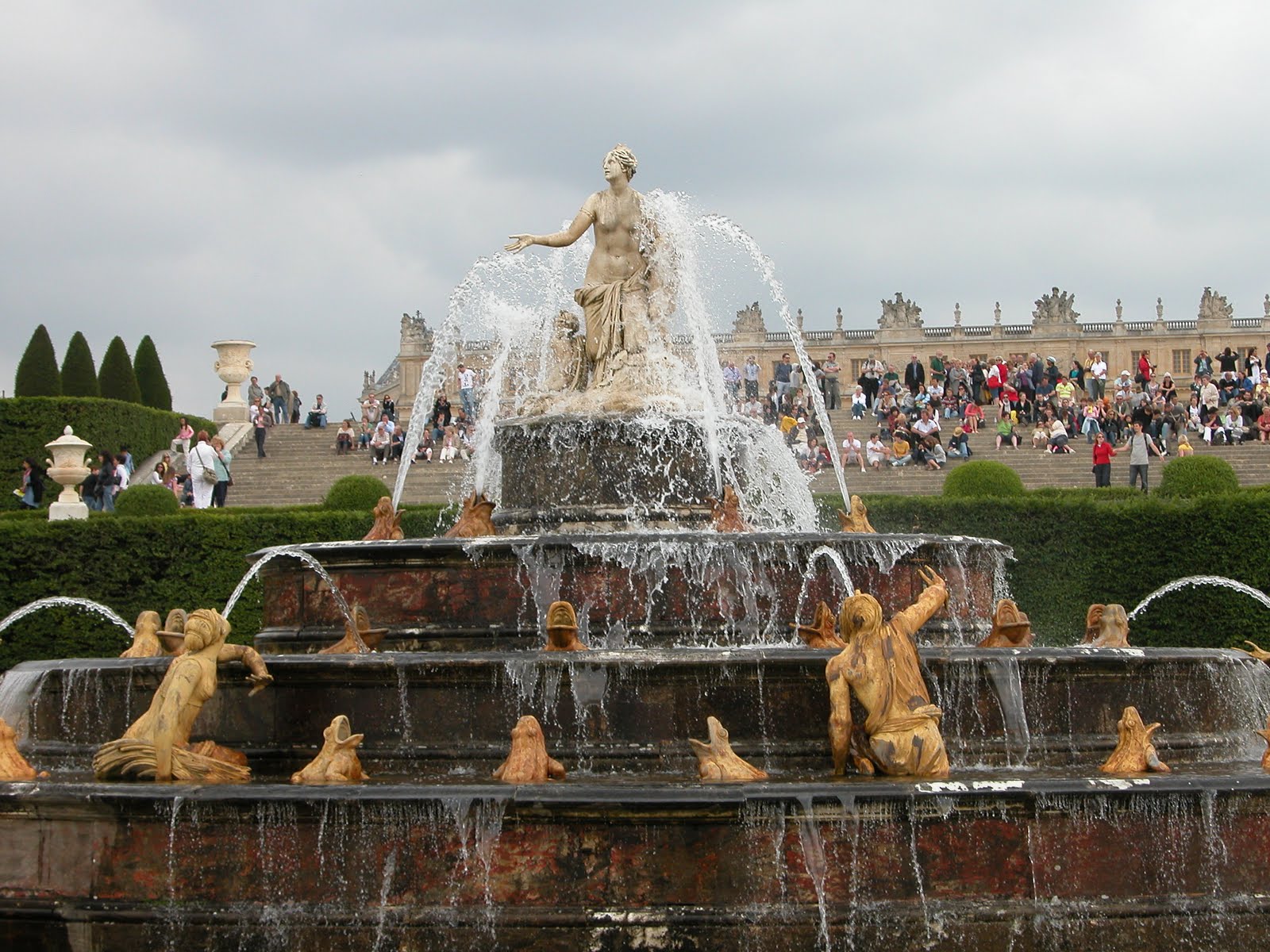
On a personal note, we went to Versailles on Saturday with students from Paris tech. The gardens are quite fantastic.
Hey, these statues look somewhat dirty/corroded. Maybe they'd let me irradiate them. I mean, really, what's the difference between a 60 year old coin and a 300+ year old statue?

Wednesday, June 9, 2010

Laser Safety Step 1: Don't Stick Your Head in the Beam Path

I went to see Yvres-Bernard this morning and picked up the laser safety video which I watched after lunch time. I went over the English version of the laser safety test that he gave me and asked Bianca to check answers with me. I then went to see him again and actually took the test with a bunch of other people, including Lee. Since my French is horrendous (translation: nonexistent) I just took the English language version. I finished in about 10 minutes, but Yvres waited for everybody to finish and discussed the answers (kindly in English and French) with everybody, so the entire test process took a little more than an hour. Afterwards, he gave me laser safety goggles on the condition that I return them at the end of July.

Just before taking the test, I talked to Valerie at LOA, who confirmed for me that if I managed to get an outside opthamologist to do the testing, my expenses would be covered. Using the HTH's doctor database, I found 8 opth. near Paris that I could go to, and with Julien's help (I'm really going to owe him by the end of the summer) I got in touch with 5 of them. I found out that 2 don't have the equipment, and of the 3 that can, one offered an appointment for 6/28, one cost about 200e, and one required that I come in for a consultation (after a month's wait) and then wait 2 months before the opth. appointment... We're going to try the other 3 tomorrow, but neither Julien nor myself are holding out much hope. Yvres-Bernard suggested asking Corrinne to get in touch with the people who usually do it and try to get my appointment moved up. I'll ask her, but I'm not sure how successful she's going to be.

On the research side of things, I finished reading another paper today.
Applied Surface Science 233, 2004
The authors begin by stating the reason for the suggestion of an incubation model, namely, materials irradiated with multiple pulses in succession were damaged at lower fluences. According to the authors, though, "the fundamental physical mechanisms of material removal during laser ablation are not clearly understood as yet."

The authors then mention 3 possible types of ablation processes: vaporization, normal boiling, and explosive boiling (also known as phase explosion, wherein materials are superheated-->vaporization). For short pulse lasers, the first two are apparently insignificant.

The authors next mentioned the morphological phenomenon of surface rippling, although they didn't say much about it. The next paper I'm reading, by Fauchet among others, deals with this explicitly.
The authors then described two ablation "phases", gentle and strong. During gentle ablation, which occurs at fluences just above the threshold the ablation rate is low, and ripples appear. Strong ablation is at fluences well above threshold, and results in rougher surface effects. The author also mentions that they are using the two step model for ablation. The model is as follows (fom Qiu and Tien, 1992, which I've half read and will finish reading soon...hopefully):
1. Incident photons interact with free electrons in the metal, exciting them to higher energy levels. The excited electrons are extremely far from thermal equilibrium and may be thought of as a free electron gas.2. The electrons diffuse through and heat the metal lattice (comprised of phonons) via electron-phonon collision. Due to the difference in mass, it takes 10s of collisions to transfer significant energy from electrons to phonons. The approximate collision time at room temperature (ambient) is 20fs, so the electron phonon relaxation time is on the order of picoseconds. If the laser pulse is much longer than this time then the electrons and phonons will reach local thermal equilibrium and a 2 step model is unnecessary. If however the pulse is shorter, the electron-phonon interaction is significant.
The authors measured the inclubation coefficients and ablation thresholds for four materials (below) using a Ti:Sapphire laser, 775 nm central wavelength, 150fs pulses, for differing numbers of shots. As predicted, as the number of incident shots was increased, the diameter of the ablated spot also increased.

The incubation model is as followed. Assuming a Gaussian beam, the diameter of the ablated spot may be described as:Where wo is the 1/e^2 beam waist, phio is the peak fluence, and phith is the ablation threshold fluence. For N shots,
One can determine the ablation threshold by plotting the first equation (for D^2) and finding the value of Phith for which D^2 is 0, since phi0 may be calculated via measuring the total pulse energy.

The results from the paper are as follows:
The authors also detailed a method for studying Phith(N) as a function of depth removed per pulse, but since that is somewhat removed from my project, I will not describe it here.